
Voice for Improv
Prague November 25
Resources
Thanks for coming to Voice for Improv workshop!
Below are some resources from what we covered in the workshop.
But first... I encourage you to sign up to the email list below!
From now, I won't be able to email you from the workshop booking platform...
By signing up, I can let you know about voice things you might be interested in...



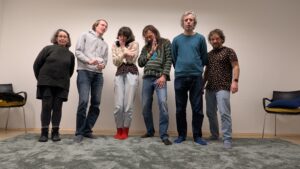


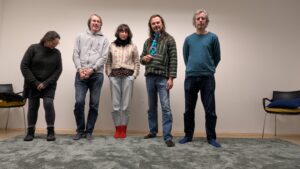
What we covered in the workshop
Voice for Improv – Prague (Nov 2025)
Still to add
Still to add
What We Explored
A 2-day deep dive into:
- Unlocking vocal freedom
- Building repeatable character voices
- Improvising with sustainable vocal choices
- Bridging body → breath → sound → character
We focused on shifting from: Habit → Awareness → Technique → Play → Performance
Day 1 — Habitual Voice, Embodied Play & New Qualities
Opening & Arrival
- Grounding and settling the room
- “Internal weather” check-in
- Naming what each person wants from their voice
Theme: Safety + curiosity → foundation of playful voicework
Session 1 — Your Habitual Improv Voice
Warm-ups to reveal:
- Where tension lives in the body
- How that tension shapes our voice
- When our voice constricts in improv
Activities included: • Improv warm-ups (“Brown Water scenes”: doing it terribly — on purpose!)
• Tension-based warm-ups: releasing before adding power
• Floorwork (Whispered “Ah”, resonance buzzing, breath resets)
Takeaway:
When we release habitual patterns, more voice becomes available.
Session 2 — Grammelot (Removing Words)
We stripped out meaning to highlight:
- Rhythm → structure
- Prosody → music of speech
- Body → emotional storytelling engine
Exercises: • Call-and-response Grammelot
• Singing syllables with beat/groove
• Single-syllable improv scenes
• Translator game — copying sounds like learning dialects
Key Insight:
Listening to how things are said is more useful than what is said.
Session 3 — Vocal Qualities
Introduction to changeable elements of voice:
- Resonance (sob, twang)
- Pitch
- Articulation clarity/shape
- Pace & rhythmic patterns
- Volume & intensity
- Prosody (vocal “music”)
Main game: Radio Scenes → Quickly shifting between bold vocal choices
Theme:
Experiment! Don’t rely on just one improv voice.
Day 2 — Creating New Voices, Making Them Healthy & Going Far
Opening & Return
- Releasing sleep tension
- “Where am I in the body today?”
- Reconnecting to breath + resonance
Trajectory:
From your voice → building other voices
Session 1 — Accents, Rhythm & Body–Voice Connection
We explored:
- How posture changes resonance
- How feet/grounding affect character
- Song-based prosody exercises
- Copying each other’s voices (body → sound)
Core Tool:
Find the voice → Get it into the body → Identify its elements
This built the skill of: ✨ Not just doing a voice — understanding how it works
Session 2 — Healthy Voice Builders
What makes a character voice sustainable?
- Unnecessary tension (strain)
- Useful activation (power)
- Hydration + efficiency
- Retraction strategies (silent laugh, yawn-breath, etc.)
🎭 We used Tom’s character voice as a case study:
- Broke it down into elements
- Adjusted posture + resonance to remove strain
- Tested it in scene work
Theme:
Repeatability = Care + Awareness + Body support
Session 3 — Integration & Emotional Range (1 → 10)
We combined:
- Qualities from Day 1
- Structure from Day 2
- Healthy vocal support
Exercises: • Partner scenes with scaling emotion • Strong emotional shifts with safe technique • 2–3 person scenes using learned voices
Takeaway:
Emotion shapes voice —
but technique keeps it safe and expressive
Themes Across the Weekend
| Theme | What We Learned |
|---|---|
| Grounding | Voice strengthens when the body stabilises |
| Awareness | Noticing tension is the first step to choice |
| Curiosity | Play unlocks characters faster than analysis |
| Embodiment | Voices live in the body — not in the throat |
| Sustainability | A great voice is one you can repeat tomorrow |
Improv expands when your voice toolbox expands.
What You Can Do Next
• Notice your vocal defaults and gently expand away from them
• Copy voices you love — play & analyse
• Track: where does each voice live in the body?
• Use Grammelot to keep freeing rhythm + boldness
• Regular reset: grounding • jaw release • soft breath-in
Continue the Journey
🎤 Click this link to join the Voice Lab Online Waitlist: https://sendfox.com/alexowenhill
Voice Videos we talked about
Here is the video we talked about from my YouTube Channel
My Research into Creating Older-Sounding Voices
I also did some research as part of my MA in Voice into creating older-sounding character voices. It includes the 3-step process for making a voice sound older that we covered in the workshop.
Follow me on my socials
© Alex Owen-Hill 2025 – AlexOwenHill.co.uk